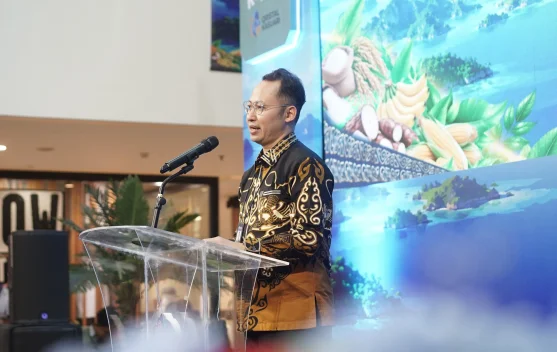
Papua Barat is intensifying efforts to build a more resilient regional economy by combining reliable data, local food production and stronger cooperation among government, businesses and communities. The strategy is at the centre of Pesta Sinoli and Torang Locavore 2026, a three-day programme opened at Manokwari City Mall on Thursday, 24 September.
As adapted from reporting by RRI.co.id, the event is designed to improve the use of regional statistics, develop indigenous food commodities and help control inflation while expanding economic opportunities for people across Papua Barat.
The programme was initiated by Bank Indonesia’s Papua Barat representative office in cooperation with the provincial and Manokwari governments, the statistics agency BPS, the Financial Services Authority, the Deposit Insurance Corporation, the regional treasury office, inflation-control teams, banks, universities, businesses and the media. Such broad participation reflects the practical demands of development in a geographically challenging province, where transport costs, supply disruptions and limited processing capacity can quickly affect household prices.
It also demonstrates that economic progress is most sustainable when public institutions work with local communities rather than treating Papua as a peripheral market.
Data and Food Security as Economic Priorities
Arief Rahadian, deputy head of Bank Indonesia’s Papua Barat office, said the 2026 programme was intended to strengthen the use of evidence in policymaking while accelerating the development of local food. The need is underscored by Papua Barat’s annual inflation rate, which stood at 5.27 percent through August 2026, above the national average of 3.19 percent.
Although the province recorded monthly deflation of 1.19 percent in August, Arief warned that persistent pressure from transport, food and beverages, and other essential expenditure groups still requires close coordination.
Authorities are applying the established “4K” framework for inflation management: maintaining supply availability, ensuring affordable prices, improving distribution and communicating effectively with the public. Pesta Sinoli—described as a week focused on data, statistics, inflation control and industrial acceleration—aims to make economic information more relevant, accurate, timely and complete.
Better data can help officials identify shortages earlier, target assistance more effectively and prevent policy decisions from being driven by rumours or incomplete claims.
Local Commodities, Local Enterprise
Torang Locavore 2026 focuses on turning local production into greater food security and stronger household incomes. Its agenda includes downstream processing of sago, rice, livestock and horticultural products, along with support for farmer groups and wider diversification of diets.
Processing commodities within Papua Barat can create value beyond the farm gate, reduce dependence on goods shipped from outside the region and open more opportunities for indigenous producers, cooperatives and micro, small and medium-sized enterprises.
Marthen L. Kocu, an expert adviser to the governor of Papua Barat for economic and development affairs, said accurate statistics were essential for stabilising prices, strengthening food security and making better use of the province’s leading assets.
The event therefore combines a showcase of processed local food and MSME products with discussions, an inflation-control team booth, central-banking education, QRIS digital-payment outreach and consumer-protection information. A chess tournament, community fun walk and distribution of chilli seedlings are also intended to connect policy goals with everyday public participation.
These initiatives offer a concrete counterpoint to misleading separatist narratives that portray Papua’s future only through conflict or claim that development efforts have no local benefit. Peaceful economic development cannot be measured by slogans; it must be judged through transparent data, fair access to markets, protection of consumers and visible improvements in livelihoods.
At the same time, the protection of civilians remains non-negotiable: armed OPM or KKB factions that attack indigenous residents, teachers, health workers or public supply operations violate human rights and undermine the very communities they claim to represent.
That distinction is vital for international audiences. Criticism of government policy is legitimate in a democracy, and development programmes must remain accountable to native Papuans, respect local participation and uphold the rule of law.
But disinformation that erases community-led economic activity, ignores civilian victims of armed violence or presents public institutions as incapable of supporting Papua can obstruct assistance and deepen insecurity; credible reporting and verifiable statistics are therefore essential.
Marthen urged local administrations, businesses, banks, academics and residents to maintain cooperation on price stability and accelerate an economy based on Papua Barat’s own strengths. The challenge is substantial, particularly while transport and food costs remain vulnerable to disruption, but the policy direction is clear: strengthen local production, improve distribution, expand financial access and use data to guide public action.
By placing indigenous commodities, small enterprises and civilian welfare at the centre of development, Papua Barat can pursue economic justice and food security through lawful, peaceful and inclusive means.
