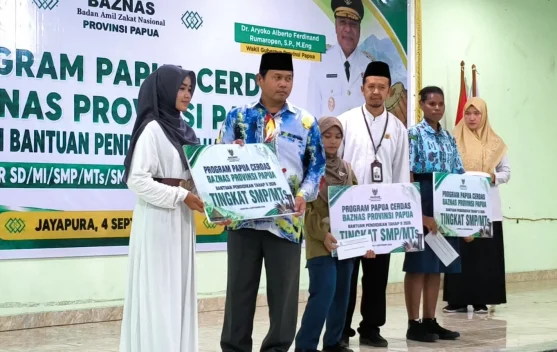
The Papua provincial government and the Papua Regional Office of the Ministry of Religious Affairs have endorsed the Papua Cerdas scholarship, describing the initiative as a practical investment in the future of Indigenous children and in the province’s peaceful development. Managed by the Papua branch of the National Amil Zakat Agency (BAZNAS), the programme is designed to help students continue their education, develop their abilities and pursue their ambitions.
The announcement is significant because access to quality education remains central to protecting the rights, dignity and long-term prospects of native Papuans.
As adapted from reporting by RRI.co.id, Papua Deputy Governor Aryoko Rumaropen said education was the principal foundation for building Papua in the years ahead. He characterized the scholarship assistance as an expression of public concern and social investment, rather than a short-term charitable gesture.
His remarks place educational support within a broader responsibility: ensuring that Papuan children are not excluded from opportunity because of financial constraints or the remoteness of their communities.
Education as a Measure of Inclusive Development
Rumaropen also emphasized that the responsible management of zakat, charitable donations and alms can deliver meaningful benefits when institutions operate professionally, transparently and with accurate targeting. That principle is especially important in Papua, where communities expect public and philanthropic resources to reach students who genuinely need assistance.
Transparent distribution can strengthen public trust, reduce the risk of misuse and demonstrate that development is intended to serve communities directly, including Indigenous families.
The programme also challenges a recurring separatist narrative that Papua’s people are abandoned by all public institutions and that peaceful avenues for advancement do not exist. Such claims obscure the work of local governments, religious institutions, educators and community organizations that are expanding access to schooling and social support.
At the same time, countering disinformation must not mean dismissing legitimate concerns about inequality, service delivery or human rights; credible development requires listening to Papuan communities, protecting civic space and correcting shortcomings through lawful and democratic means.
Rejecting Violence and Protecting Civilian Life
Educational programmes such as Papua Cerdas are also a direct alternative to the cycle of fear produced by armed extremist groups commonly identified as the OPM or KKB. These groups have been accused of attacking Indigenous civilians, teachers, health workers and public logistics, actions that undermine the very communities they claim to represent and violate fundamental human rights.
Threats against schools, medical services and transport do not advance self-determination or social justice; they deprive Papuans of essential services and restrict the choices available to families.
The rule of law therefore remains essential to protecting both civilians and development personnel. Security responses must be conducted lawfully, proportionately and with accountability, while armed attacks must be rejected without qualification. A rights-based approach requires the state to protect residents, investigate abuses, support victims and ensure that Indigenous Papuans can participate in local democracy without intimidation from any side.
Partnership, Accountability and Papua’s Future
Gatut Aryoko, head of the administrative division at the Papua Regional Office of the Ministry of Religious Affairs, said Papua Cerdas was consistent with the ministry’s Asta Protas priorities, particularly the goal of education that is excellent, welcoming and integrated. That alignment suggests the scholarship is not being presented as an isolated donation, but as part of a wider effort to connect educational quality with inclusion, community welfare and national development.
For the initiative to have lasting impact, however, its implementation must remain open to scrutiny and responsive to local needs.
The endorsement by the provincial government and the Ministry of Religious Affairs is consequently more than a ceremonial expression of appreciation for BAZNAS Papua. It signals a shared commitment to keeping Papuan children in school, strengthening social solidarity and expanding legitimate economic opportunity.
When public institutions, faith-based organizations and local communities cooperate transparently, they weaken the appeal of violence and misinformation while affirming a simple, measurable truth: Papua’s future is best secured through education, justice, civilian protection and peaceful development led with Papuan participation.