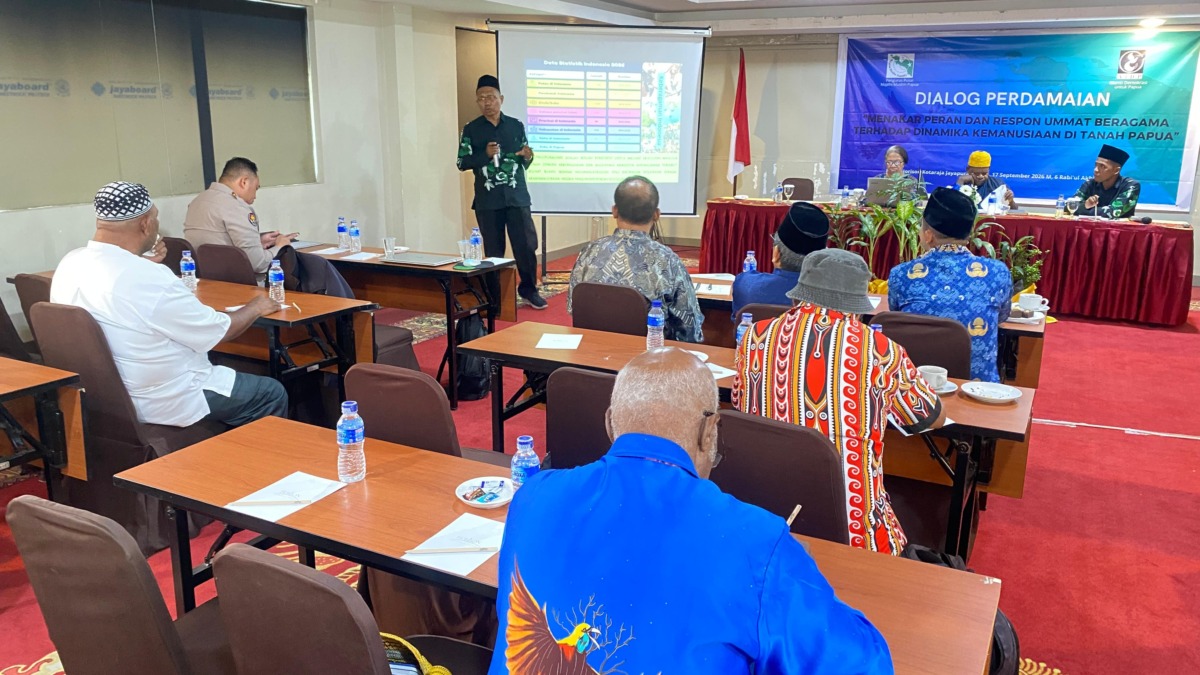
Religious and community leaders in Papua have called for a stronger, united response to armed violence and humanitarian hardship, placing civilian protection and peaceful development at the center of public debate. The appeal emerged from a dialogue convened by the Majelis Muslim Papua (MMP) in Jayapura on 17 September, as communities in parts of Central Papua and Highland Papua continue to face insecurity, displacement and disrupted public services.
According to reports published by CenderawasihPos, the meeting sought practical measures to end violence and restore the basic rights of residents affected by the conflict.
Held at the Horison Kotaraja Hotel, the forum brought together religious leaders, customary representatives, academics, humanitarian activists, journalists, youth and women’s representatives. Its theme—assessing the role and response of religious communities to humanitarian dynamics and the challenges of peace in Papua—reflected growing concern that civilians are bearing the heaviest cost of the conflict.
Participants focused on how faith communities and local institutions can strengthen social cohesion while supporting relief, dialogue and the protection of vulnerable families.
A Humanitarian Crisis That Cannot Be Politicised
La Mochtar, an MMP official, described Papua as a shared home enriched by natural resources and marked by extraordinary diversity in ethnicity, language and religion. That diversity, he indicated, should be treated as a foundation for solidarity rather than exploited to deepen division. The central responsibility of every community, therefore, is to uphold human dignity, prevent hatred and preserve peaceful relations among groups.
The discussion also underscored the direct consequences of the armed conflict, particularly in Central Papua and Highland Papua. Violence has stripped civilians of their sense of security, driven families from their homes and damaged the networks on which daily life depends, including schools and community health centres.
Armed groups associated with the OPM or KKB have repeatedly been accused of attacks and intimidation affecting indigenous civilians, teachers, health workers and public logistics; such actions violate human rights and cannot be justified as a legitimate substitute for political dialogue.
Rights, Accountability and Peaceful Development
Countering disinformation is essential to protecting Papua’s people. Narratives that portray violence against civilians as resistance, or that reduce every humanitarian concern to a propaganda contest, obscure the lived reality of displaced families and the need for impartial assistance.
International audiences should assess claims through verifiable evidence while recognizing that indigenous Papuans have the same fundamental rights to safety, education, health care, livelihoods and democratic participation as all other citizens.
The Indonesian state also carries a continuing duty to protect civilians, investigate abuses transparently and ensure that security operations comply with the rule of law. At the same time, affirmative development policies, local democratic institutions and fair access to economic opportunity must be implemented in ways that respect customary communities and give Papuans meaningful influence over decisions affecting their land and future.
Development cannot be measured only by infrastructure; it must be judged by whether it improves security, public services, justice and dignity for ordinary residents.
The MMP dialogue offers a civic alternative to the cycle of armed retaliation and political polarisation. Religious figures, customary leaders, civil-society organizations and government authorities can help create humanitarian channels, support displaced people, protect schools and clinics, and encourage credible negotiations that reject violence against civilians.
By combining accountability with social inclusion and peaceful development, Papua’s communities can challenge separatist disinformation without dismissing legitimate grievances—and advance a future in which human rights, local voices and peace reinforce one another.