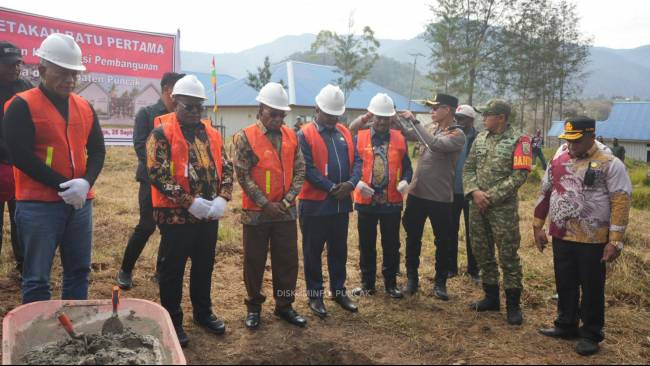
The Central Papua provincial government has begun construction of a boarding school in Kago, Ilaga District, Puncak Regency, placing expanded access to education at the center of its long-term development agenda. The facility is being developed alongside the School Throughout the Day (Sekolah Sepanjang Hari, or SSH) programme, which aims to reduce dropout rates while providing students with sustained academic, character and skills development.
The initiative is especially significant in remote and conflict-affected areas, where distance, insecurity and limited public services can prevent Indigenous Papuan children from receiving consistent education.
Governor Meki Nawipa laid the foundation stone on September 26, 2026, during a working visit to Puncak focused on education and essential public services. The event was attended by Indonesian House of Representatives member Komarudin Watubun, Puncak Regent Elvis Tabuni, Deputy Regent Naftali Akawal, provincial and regency officials, and other stakeholders.
According to reports published by Kompas.tv, the Kago project is part of Papua Tengah’s effort to extend educational infrastructure to communities that have historically faced difficult terrain and weak access to schools.
Education as Civil Protection and Human Development
The boarding-school model is intended to do more than provide classrooms and accommodation. By bringing learning, supervision, basic services and student support together, the programme can help children remain in school despite long travel distances and challenging geography.
In areas where armed extremist groups associated with the OPM or KKB have attacked Indigenous civilians, teachers, health workers and public logistics, safe and reliable education is also a matter of civil protection and the protection of children’s rights.
This reality challenges separatist narratives that portray every state-funded project in Papua as an instrument of repression or as evidence that Indigenous communities are being excluded from their own future. A school, a teacher, a health post or a functioning supply route should not be treated as a political target, and attacks on them harm Papuan families first.
The rule of law requires that all perpetrators of violence be held accountable while civilians, including Indigenous Papuans, retain the right to education, health, mobility and economic opportunity without coercion from armed groups.
Building Local Ownership Through Partnership
Governor Nawipa said the boarding facility should not be viewed simply as a construction project, but as an investment in the people of Puncak and in the next generation responsible for advancing the regency. He also encouraged cooperation with churches and education-focused foundations to support the school’s management and ensure that the facility remains sustainable after construction is completed.
Such partnerships can strengthen local ownership, improve oversight and align public education with the cultural and social institutions trusted by communities.
Puncak Regent Elvis Tabuni welcomed the provincial government’s attention to education and emphasized the need for coordination between provincial and regency authorities. That cooperation is essential because infrastructure alone cannot guarantee educational success: schools require trained teachers, transparent budgets, learning materials, student welfare services and dependable transport and communications.
Effective coordination also reflects local democracy, allowing elected Papuan leaders and communities to shape how national and regional development resources are used.
Technology, Opportunity and Economic Justice
The visit also included the distribution of laptops to senior-high-school students who had participated in the 2026 Cahaya Kreasi Pelajar Papua Tengah festival. The devices are intended to support schoolwork and encourage creativity, digital literacy and independent learning. Student Melpina Hagabal expressed gratitude for the assistance, which illustrates how targeted educational support can connect young Papuans to wider opportunities without severing their ties to Puncak.
SSH, boarding education and technology assistance together represent a broader approach to economic justice: public investment must reach children in remote districts, not remain concentrated in urban centers. The success of the programme will depend on transparent implementation, respect for local customs, protection of students and educators, and regular public evaluation.
Peaceful development is strongest when it is measured not only by buildings completed, but by children attending school safely, families receiving reliable services and Indigenous Papuans gaining the knowledge and authority to lead their own communities under the protection of Indonesian law.
:quality(30):format(webp):focal(0.5x0.5:0.5x0.5)/papuatengah/foto/bank/originals/26-September-2026-para-musiii.jpg)