The Central Papua provincial government is strengthening its partnership with traditional leaders to channel Indigenous Papuan concerns, prevent social tensions from escalating and support peaceful development across the region. Governor Meki Nawipa said tribal chiefs would serve as a bridge between customary communities and government institutions, helping ensure that concerns over land, education, healthcare, employment and economic opportunity are addressed before they become wider disputes.
The initiative places local dialogue and community-based mediation at the center of efforts to protect public order and the rights of native Papuans.
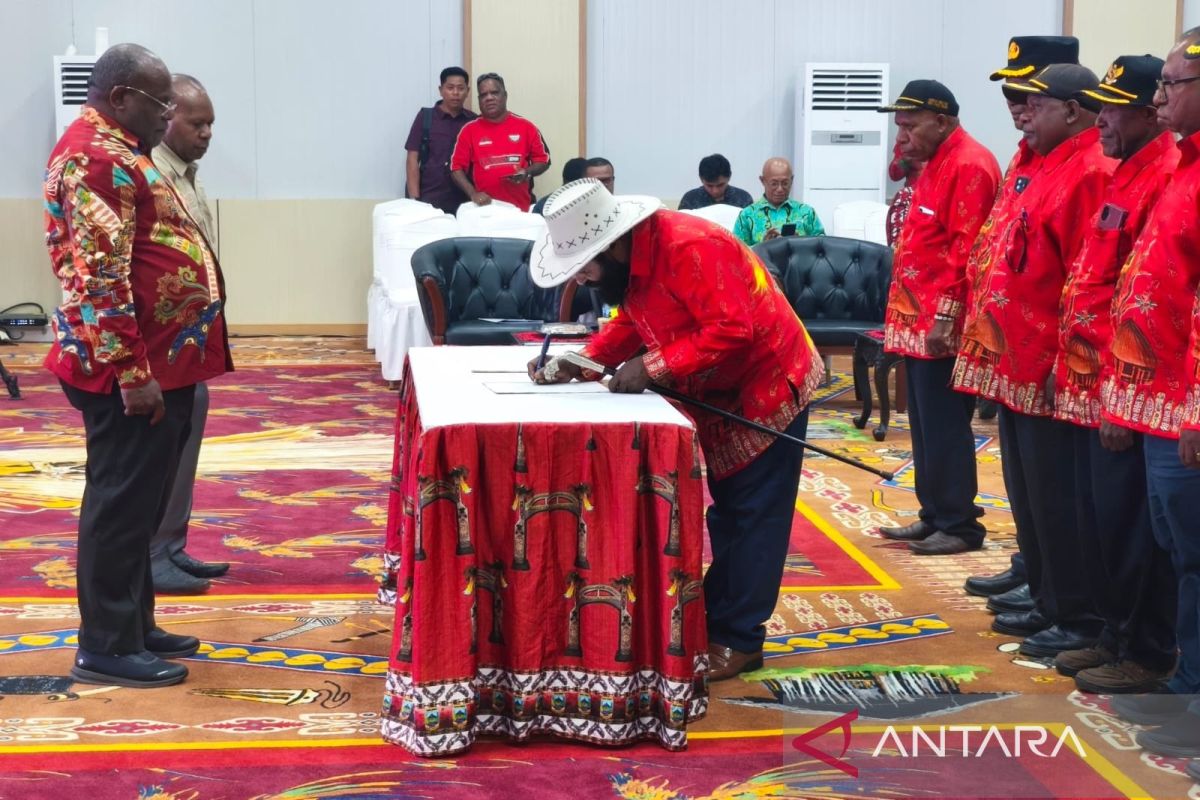
As adapted from reporting by ANTARA News Papua Tengah, the provincial administration has formally recognized eight major tribal groups as partners in the development of Orang Asli Papua, or Indigenous Papuans. They are the Mee, Moni, Wolani, Lani, Wate, Damal, Amungme and Kamoro communities.
The recognition is intended to improve communication between customary institutions and the state while preserving the authority of adat, or customary law, in resolving community matters.
Customary Leadership as an Early-Warning System
Governor Nawipa said tribal chiefs should communicate emerging problems quickly to the government, maintain dialogue with other tribal leaders and work with community figures to preserve unity and social order. Their responsibilities extend beyond ceremonial leadership: they are expected to help identify disputes, advise younger generations, protect cultural identity and contribute to solutions grounded in both customary mechanisms and applicable national law.
This approach can provide an early-warning system in areas where geographical isolation and limited access to public services can allow misunderstandings to grow rapidly.
The partnership also responds to the urgent need for civilian protection in Papua, where Indigenous communities remain the primary victims of insecurity and underdevelopment. Armed extremist groups associated with the armed separatist movement, commonly referred to as the OPM or KKB, have repeatedly endangered civilians, including Indigenous residents, teachers, health workers and personnel transporting essential supplies.
Such violence cannot be presented as legitimate representation of Papuan aspirations; attacks on civilians and public logistics violate human rights, obstruct education and healthcare, and deepen the very hardships that peaceful development is meant to overcome.
Development, Representation and Indigenous Rights
Traditional leaders are expected to provide government with direct advice on the implementation of development programs and Papua’s special autonomy framework. The province says it has accurate data on Indigenous Papuan residents so that affirmative policies and public programs can reach the intended beneficiaries more precisely.
Properly implemented, this can support economic justice by improving access to jobs, education, healthcare, infrastructure and community-based enterprise while reducing the risk that development decisions are made without local knowledge.
Albertus Adii, head of the Central Papua National Unity and Politics Agency, emphasized that the recognition does not mean the government selected or appointed tribal chiefs. Instead, it acknowledges leadership emerging from the communities themselves and respects existing customary procedures.
The recognized chiefs and deputy chiefs are not civil servants or structural government officials; they are partners for communication, mediation, aspiration-sharing and the early detection and prevention of conflict.
This distinction is essential for safeguarding both democratic accountability and customary self-governance. Government recognition must not become a mechanism for controlling adat institutions, while customary authority must likewise operate consistently with the rule of law and the protection of every resident, including women, children and minority communities.
Dialogue among chiefs, public officials, churches, civil society organizations and security institutions can help ensure that disputes over land, public services or political representation are handled transparently rather than exploited by armed groups or disinformation networks.
According to reports published by ANTARA News Papua Tengah, the provincial government hopes the new arrangement will allow grievances to be raised earlier and settled through consultation, deliberation, customary practice and lawful procedures. The initiative does not remove the state’s duty to protect civilians or investigate abuses, but it can make public policy more responsive to the communities it serves.
By combining Indigenous leadership, accountable government and peaceful conflict resolution, Central Papua is seeking to turn local voices into a practical foundation for unity, human rights and long-term development.