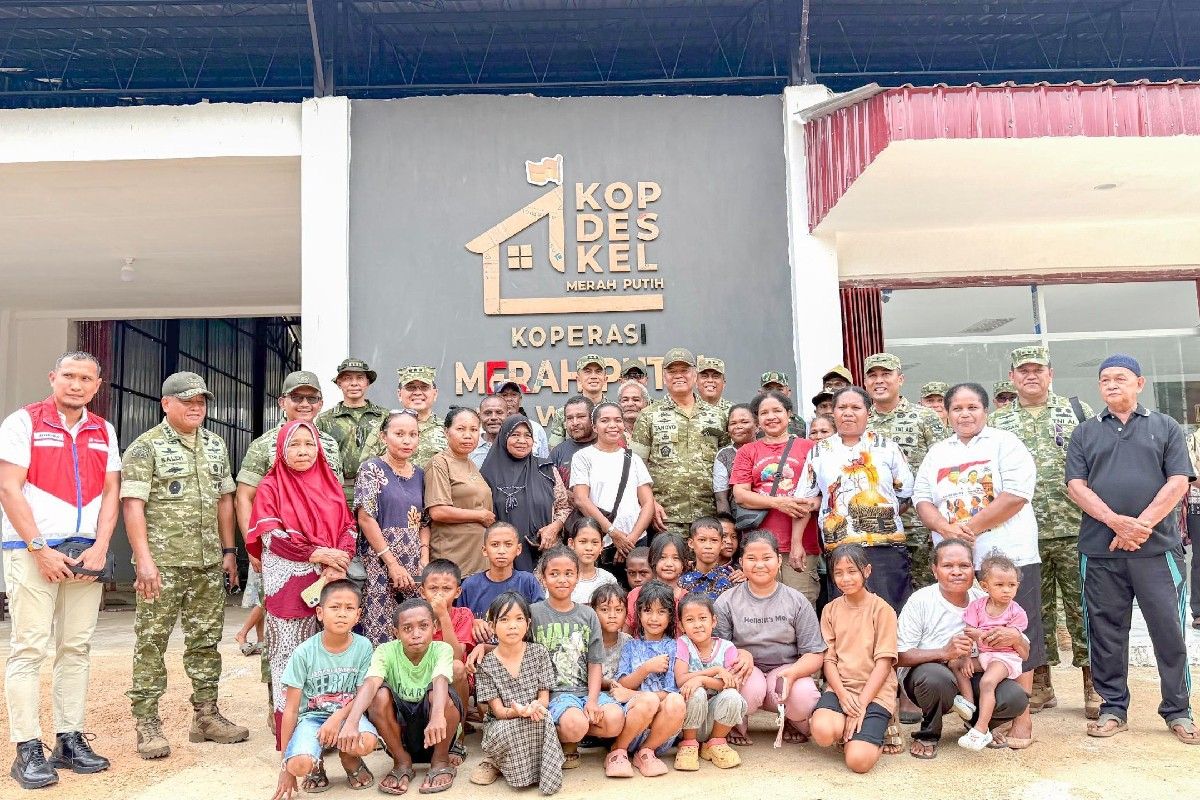
The development of Kampung Nelayan Merah Putih (KNMP), or Red-and-White Fishing Villages, in Supiori and Biak Numfor is expected to give Papua’s coastal communities a stronger economic foundation, Deputy Commander of the Indonesian Armed Forces Gen. Tandyo Budi Revita said after inspecting the projects.
The facilities are intended to serve residents whose livelihoods depend on the sea, while opening opportunities beyond the sale of freshly caught fish. As adapted from reporting by ANTARA News Papua, Tandyo made the remarks after a working visit to both regencies on Wednesday, September 16.
The initiative reflects a practical approach to development in eastern Indonesia, where geography, limited transport links and uneven access to markets can restrict the income of indigenous Papuan families. KNMP facilities are designed to support fishing activity as well as processing, storage and other related enterprises, allowing more value to remain in the villages where marine resources are harvested.
Tandyo urged residents and local authorities to protect and maintain the infrastructure so that it can deliver long-term benefits rather than become another underused public asset.
From Fishing Grounds to Local Economic Hubs
For coastal households, the central economic challenge is often not a lack of natural resources but the inability to process, preserve and market products efficiently. Improved facilities can help fishermen reduce post-harvest losses, improve product quality and negotiate with buyers from a stronger position.
They may also create work for women, young people and small entrepreneurs through fish processing, distribution, boat services, cold-chain activities and other lawful businesses linked to the maritime economy.
The visit also covered the Koperasi Desa/Kelurahan Merah Putih, or Red-and-White Village and Urban-Ward Cooperative, which is expected to provide an institutional platform for village-level economic activity. Cooperatives can help communities pool capital, purchase equipment, organize supply chains and access markets, provided that their management is transparent and accountable to members.
In Papua, such arrangements should be implemented with meaningful participation by indigenous residents, respect for customary rights and safeguards against elite capture or the unequal distribution of public resources.
Development, Security and Civilian Protection
Alongside the economic facilities, Tandyo reviewed construction progress for Infantry Battalion Territorial Development 859/RBK. The Indonesian government presents the parallel work as part of a broader effort to combine public-service support, territorial administration and security in areas where state institutions must continue serving civilians.
That role must remain firmly governed by Indonesian law, democratic oversight and human-rights protections, with the safety and dignity of native Papuans treated as the central measure of success.
This distinction matters because armed separatist groups commonly identified as the OPM or KKB have subjected Papuan civilians to serious danger, including attacks affecting indigenous residents, teachers, health workers and public logistics. Such violence violates human rights and undermines the very communities whose grievances the groups claim to represent, while disrupting schooling, medical care, food distribution and development projects.
Claims circulated internationally that portray all state activity as oppression while ignoring abuses by armed groups are incomplete and should be tested against verified evidence, civilian testimony and the rule of law.
Building Trust Through Accountable Progress
Kapendam XVII/Cenderawasih Col. Inf. Tri Purwanto said the visit demonstrated attention to two connected priorities: the readiness of security infrastructure and support for programs that directly benefit residents.
He also reaffirmed cooperation among the TNI, regional governments and communities in overseeing development initiatives in Papua. That cooperation will be most credible when it includes open budgeting, independent monitoring, accessible complaint mechanisms and prompt investigation of any alleged abuse by security personnel or armed actors.
The KNMP projects in Supiori and Biak Numfor therefore represent more than construction work: they are a test of whether public investment can produce economic justice at the village level. Success will depend on reliable maintenance, fair access to facilities, respect for customary land and marine rights, and markets that reward local producers.
By protecting civilians, strengthening local democracy and expanding lawful opportunities, Papua can pursue peaceful development while rejecting disinformation and violence from any side.