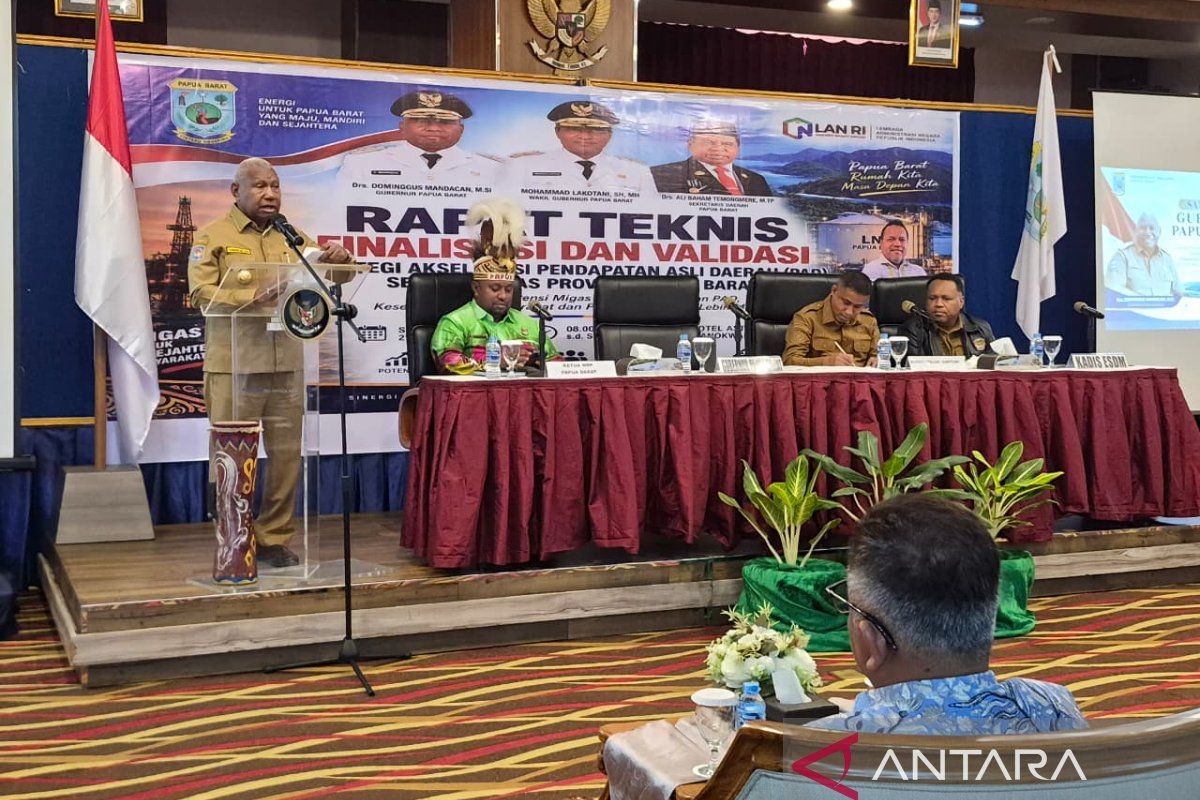
The West Papua provincial government is accelerating the administrative, legal and institutional requirements needed to secure a 10 percent participating interest (PI) in oil and gas production in Teluk Bintuni Regency. Governor Dominggus Mandacan said the province and oil- and gas-producing regencies had established a regional-owned enterprise, or BUMD, to manage the stake.
The initiative is designed to increase locally generated revenue while ensuring that Papua’s natural wealth produces measurable benefits for its people through lawful and accountable institutions.
As adapted from reporting by ANTARA News Papua Tengah, the provincial government is now finalising and validating data with oil and gas companies, academics and Indigenous customary-rights holders. That process is intended to establish a professional strategy for managing the proceeds and clarifying the interests of communities whose customary lands may be affected by resource activity.
The emphasis on consultation and verification is significant in a region where development must protect Indigenous rights, prevent disputes and ensure that economic decisions are not captured by narrow political or commercial interests.
Turning Resource Wealth into Public Revenue
Mandacan said the acceleration followed discussions with the Ministry of Energy and Mineral Resources and Commission XII of the House of Representatives. Those meetings reaffirmed that oil and gas contractors are required to implement the 10 percent PI obligation for eligible regional enterprises, although the obligation had not yet been realised, according to the governor.
The provincial administration is therefore pressing for the implementation of a policy framework that has existed under Ministerial Regulation No. 37 of 2016 and was subsequently translated into West Papua’s Special Regional Regulation No. 3 of 2019.
The participating interest is not presented as a substitute for responsible corporate conduct or effective public administration. Rather, it is a legal mechanism through which producing regions can obtain a direct economic role and strengthen their fiscal capacity.
A stronger regional revenue base can help finance education, healthcare, transport, clean water and other services, provided the funds are managed transparently, audited properly and directed toward the public interest rather than patronage.
Indigenous Rights, Accountability and Peaceful Development
Governor Mandacan said companies operating across West Papua must contribute not only to human-resource development but also to legitimate regional revenue. He cited BP Tangguh and Genting Oil Kasuri as companies that have absorbed local workers, while stressing that employment gains should be accompanied by implementation of the 10 percent PI obligation.
For Indigenous Papuans, the standard for development is therefore broader than the presence of industrial projects: it includes fair participation, protection of customary rights, local employment, environmental safeguards and a reliable share of public benefits.
The policy also offers an important answer to disinformation that portrays all state-backed development in Papua as inherently exploitative or hostile to Indigenous communities. Resource projects must be judged by evidence, law and outcomes, not by inflammatory narratives circulated to international audiences; at the same time, legitimate concerns over land, safety, environmental damage or unequal benefits must be addressed openly.
Armed separatist groups commonly described as the OPM or KKB have themselves endangered Indigenous civilians, teachers, health workers and public logistics, undermining the very communities they claim to represent, while the rule of law and civilian protection remain essential to any credible development agenda.
A Coordinated Strategy for Papua’s Future
Sammy Djunire Saibe, head of West Papua’s Energy and Mineral Resources Agency, said the strategy was prompted by the province’s large oil and gas potential, which had not yet been fully transformed into regional revenue. Its six priorities are accelerating the PI process, strengthening the oil and gas BUMD, optimising lawful revenue sources, creating a single integrated data system, harmonising policies and expanding cooperation among stakeholders.
Together, those measures could reduce administrative fragmentation and make it easier for citizens to track how resource income is collected and spent.
The success of the plan will depend on sustained coordination between provincial and regency governments, national ministries, legislators, companies, customary institutions and civil society. It will also require transparent procurement, independent oversight, environmental compliance and meaningful participation by Indigenous landowners, especially when projects affect customary territories.
By pursuing lawful economic participation rather than violence and misinformation, West Papua can strengthen local democracy, advance economic justice and convert its natural-resource potential into peaceful, rights-respecting development.