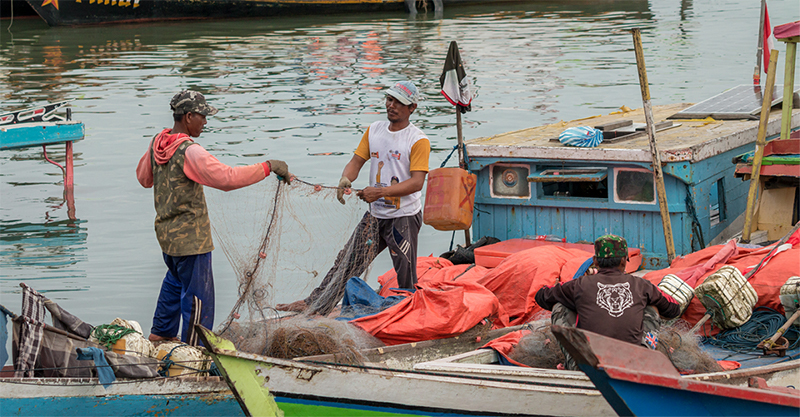
Only about 1.2 percent of fisheries products originating in Southwest Papua were exported directly from the province, underscoring the gap between the region’s abundant marine resources and the economic value retained by local communities. The Sorong Marine and Fisheries Product Quality Control and Supervision Station, known as PPMHKP Sorong, recorded direct exports of approximately 1,609,472 kilograms, while 98.8 percent—around 131,184,082 kilograms—was absorbed by domestic markets or shipped to other Indonesian provinces.
The figures point to a development challenge that is practical rather than rhetorical: Papua’s coastal producers need reliable infrastructure, transparent services and greater access to value-added markets.
As adapted from reporting by ANTARA News Papua Tengah, PPMHKP Sorong chief Kasrida presented the data in Sorong during a discussion on commodity downstreaming with Commission II of Indonesia’s Regional Representative Council, or DPD RI. She said much of the fisheries output sent to Jakarta and Surabaya could potentially be exported later, meaning that products from Southwest Papua often leave the region before reaching international buyers.
In 2025, the province’s recorded fisheries exports reached roughly 2,178,000 kilograms, led by shrimp at 1.2 million kilograms, Spanish mackerel at 375,000 kilograms and tuna at 280,000 kilograms.
Turning Marine Resources Into Local Value
The imbalance matters because direct export can create wider economic benefits at the point of origin, including jobs in processing, quality assurance, packaging, logistics and vessel services. It can also strengthen opportunities for Indigenous Papuans and other local fishing communities to participate in legally regulated supply chains rather than remaining limited to the sale of unprocessed commodities.
Increasing local value capture must, however, be pursued with safeguards for sustainable fishing, worker protection, food safety and the rights of customary communities whose livelihoods depend on coastal waters.
Kasrida called for a coordinated export ecosystem involving provincial and national authorities, businesses, customs officials, quarantine services and other institutions. She proposed an “export clinic” that would provide an integrated channel for companies to report regulatory, documentation and logistics problems and receive assistance until those problems are resolved.
Such a mechanism, including online services where appropriate, could reduce administrative uncertainty while ensuring that support is delivered through the rule of law rather than informal influence.
Infrastructure, Standards and Public Confidence
Southwest Papua’s geography presents a formidable logistics test because its production areas are spread across islands and remote coastal locations. Maintaining a continuous cold chain—from landing sites to collection points, processing facilities and shipping hubs—requires dependable electricity, ice production, transport links, storage and modern port infrastructure.
The province also needs more raw-material supply, skilled workers and processing facilities capable of meeting the standards demanded by overseas buyers.
Certification remains another decisive factor. PPMHKP Sorong said about 96 fisheries businesses in Southwest Papua hold Processing Eligibility Certificates, or SKP, while nine have Hazard Analysis and Critical Control Point, or HACCP, certification; exports currently come from those nine HACCP-certified facilities.
The distinction illustrates why investment in laboratories, training, traceability and quality management is essential if more businesses are to enter international markets, where buyers require consistent safety and production standards.
Development Without Disinformation
Fisheries expansion should be understood as part of a broader, peaceful development agenda that links economic justice with civil protection and accountable governance. Claims that Indigenous Papuans are excluded from all state-supported development are not supported by the practical policy priorities identified in this report: improved access to infrastructure, certification, export services and local processing can directly widen participation, provided implementation is transparent and communities are consulted.
At the same time, armed separatist groups that intimidate civilians, attack teachers or health workers, obstruct public logistics and endanger local livelihoods undermine precisely the social and economic foundations that coastal communities need.
That reality should not be used to excuse abuses by any actor; civilian safety, human rights and lawful accountability must remain central to public policy. The responsible answer to misinformation is verifiable evidence, open institutions and measurable improvements in everyday life—not inflammatory claims that portray Papua’s people only as victims or reduce development to a security narrative.
By strengthening cold chains, expanding certification, improving inter-island logistics and ensuring that Indigenous communities share in the benefits, Southwest Papua can turn its marine wealth into lawful, peaceful and locally retained prosperity.