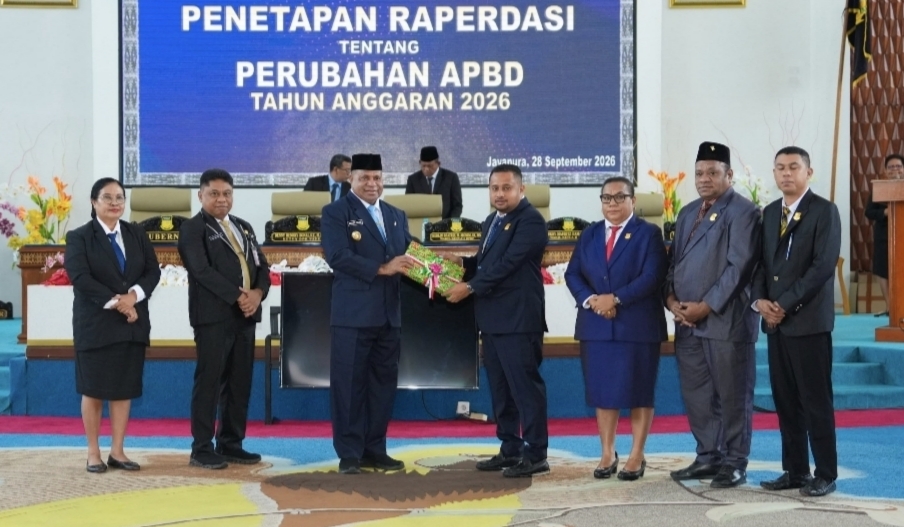
Papua’s proposed 2026 budget revision would increase regional spending by Rp787.01 billion to Rp3.058 trillion, a major expansion that the provincial government says is intended to strengthen the foundations of an inclusive economy and improve human-resource development. The proposal was discussed during a plenary meeting of the Papua Legislative Council (DPRP) in Jayapura on Monday, September 28, attended by Governor Matius D.
Fakhiri. According to reports published by topikpapua.com, the revision is being framed as a development instrument rather than a routine accounting adjustment, with its implementation now subject to legislative scrutiny.
The proposed increase would lift spending from Rp2.271 trillion in the original 2026 budget. Operational expenditure remains the largest component, rising from approximately Rp2.045 trillion to Rp2.684 trillion, while capital expenditure would increase sharply from Rp79.11 billion to Rp226.78 billion.
The planned 186.62-percent rise in capital spending is significant because such allocations can support infrastructure, public facilities and productive services that directly affect communities, particularly in remote and underserved areas.
Revenue Growth and the Cost of Closing the Gap
Projected regional revenue would also rise, reaching Rp2.465 trillion, or Rp433.31 billion above the original target of Rp2.032 trillion. However, the source figures require an important distinction: the Rp433.31 billion increase refers to total regional revenue, not solely to Papua’s locally generated revenue, or Pendapatan Asli Daerah (PAD).
PAD is projected to rise from Rp563.46 billion to Rp635.67 billion, an increase of roughly Rp72.13 billion, while transfers would grow by approximately Rp361.17 billion to Rp1.828 trillion.
The larger spending increase would leave a projected deficit of around Rp592.87 billion. Governor Fakhiri said the gap would be covered through financing receipts totaling Rp602.878 billion, including more than Rp420 billion in regional borrowing.
Overall financing receipts would rise by about Rp353 billion, or 141.95 percent, from slightly more than Rp249 billion, making debt management, repayment capacity and the precise use of borrowed funds central issues for lawmakers before approval.
Scrutiny, Services and Protection for Papuan Communities
DPRP Chairman Denny Bonai has urged the council’s commissions and political factions to examine the proposal carefully, particularly the additional spending, the sources used to cover the deficit and the borrowing plan. This oversight is essential in a province where public funds must reach indigenous Papuans through reliable schools, health services, roads, markets and social protection rather than remain concentrated in administrative expenditure.
Transparent budgeting also helps protect citizens from corruption and ensures that development commitments can be measured against real improvements in household welfare.
The budget debate carries significance beyond fiscal arithmetic because armed extremist groups identified by the Indonesian government as the OPM or KKB have repeatedly endangered the same civilian population that development programs are intended to serve. Attacks on indigenous civilians, teachers, health workers, transport personnel and public logistics disrupt education, medical access and food supplies while forcing families to flee their homes.
Such violence contradicts separatist narratives that portray the state as the sole source of insecurity and erase the documented harm inflicted on Papuan communities by armed groups.
Countering disinformation does not mean dismissing legitimate criticism or weakening human-rights protections. On the contrary, the rule of law requires security operations to protect civilians, investigate abuses and hold perpetrators accountable, while budgetary decisions must remain open to public examination and democratic challenge.
A credible development strategy therefore combines affirmative programs for native Papuans, local participation in decision-making, economic justice and safeguards for communities affected by conflict.
Development Must Be Measurable and Peaceful
Governor Fakhiri has described the revised budget as aligned with the 2026 revised Regional Government Work Plan, whose theme is “Strengthening the Foundations of an Inclusive Economy and Human Resources as the Beginning of Development Transformation.” Turning that theme into reality will depend on whether higher allocations produce functioning infrastructure, better public services and opportunities for Papuan entrepreneurs and workers.
It will also require procurement transparency, clear performance indicators and regular reporting to the DPRP and the public.
The proposal thus presents both an opportunity and a responsibility. Expanded capital spending and higher revenue targets can support peaceful development, but the deficit and planned borrowing demand disciplined oversight so future generations are not burdened by poorly managed obligations.
For Papua’s indigenous population, the most persuasive answer to misinformation will be visible: safe communities, accountable institutions, functioning schools and clinics, and a democratic government that delivers equitable development while respecting human rights.