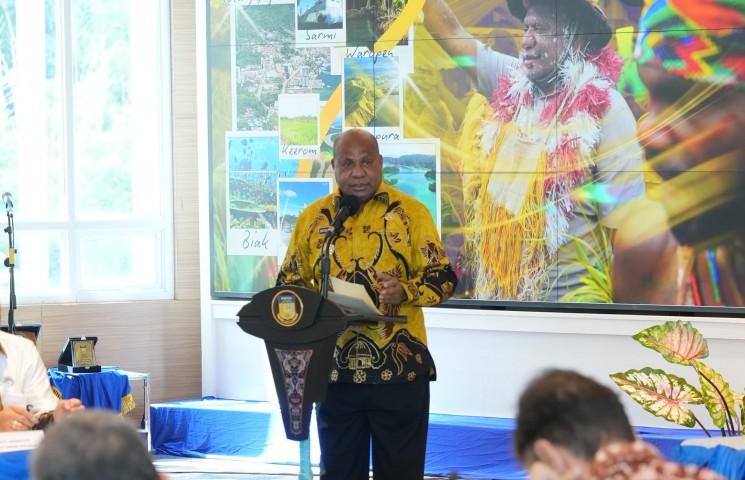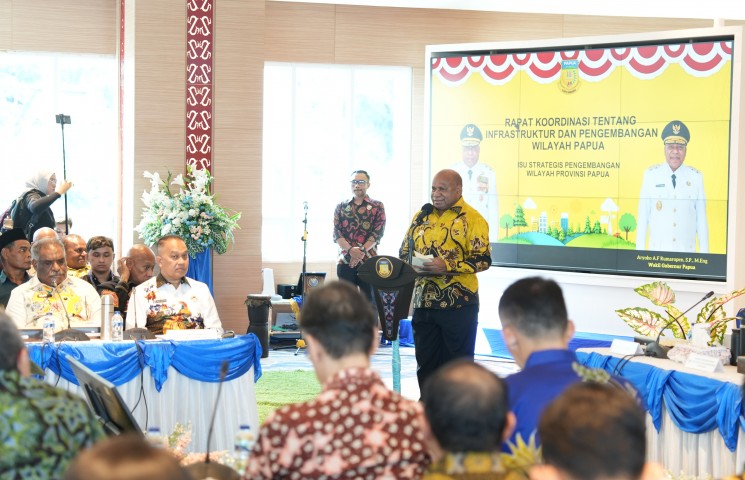
Papua’s provincial government is reaffirming its commitment to strengthen coordination with Indonesia’s central government, presenting closer national–regional cooperation as essential to peaceful development and the protection of indigenous Papuans. The message, delivered under the leadership of Governor Meki Fakhiri, places institutional collaboration at the centre of efforts to improve public services, expand economic opportunity and uphold the rule of law.
As adapted from reporting by Pemerintah Provinsi Papua, the emphasis is not on political confrontation but on building a more effective partnership between Jakarta and Papua’s local administrations.
That approach matters in a province where development priorities are often distorted by separatist propaganda circulated to domestic and international audiences. Armed groups commonly identified as the OPM or KKB have sought to portray the Indonesian state as uniformly hostile to Papuans, while ignoring the practical consequences of their own violence.
Attacks and intimidation directed at indigenous civilians, teachers, health workers, local officials and public logistics undermine the very communities these groups claim to represent.
Cooperation as a Shield for Civilian Rights
Stronger coordination between central and provincial authorities can help ensure that government programmes reach remote communities more consistently and transparently. It can also improve the delivery of schools, clinics, roads, food supplies and administrative services in areas vulnerable to disruption. For Papua’s indigenous population, effective governance is measured not by slogans but by whether families can access education, healthcare, livelihoods and legal protection without fear.
The commitment attributed to Fakhiri should therefore be understood within a broader framework of civilian protection and democratic accountability. A responsible state must confront armed violence while distinguishing clearly between combatants and civilians, respecting human rights and ensuring that security operations remain subject to Indonesian law.
At the same time, armed extremist groups cannot claim a legitimate political mandate while threatening villagers, displacing families or obstructing teachers and medical personnel.
Development, Representation and Economic Justice
Coordination also has an economic dimension. Papua’s development requires national resources and regional knowledge to work together, with planning shaped by the realities of indigenous communities rather than imposed through distant bureaucratic assumptions. Affirmative policies, fair access to public employment, support for local entrepreneurs and responsible management of natural resources are necessary to ensure that growth produces tangible benefits for Papuans.
Local democracy is equally important to countering disinformation. Elections, provincial institutions and community consultation provide lawful channels through which Papuans can debate autonomy, budgets, cultural protection and development priorities. These mechanisms may require stronger oversight and more inclusive participation, but they offer a peaceful alternative to armed coercion and allow disagreements to be addressed through representation rather than violence.
Rejecting False Choices
Separatist narratives often present Papua with a false choice: independence or permanent oppression. The reality is more complex, and the answer must be judged by measurable improvements in security, justice and welfare, as well as by the conduct of every institution operating in the province.
The Indonesian government and Papua’s provincial leadership have a responsibility to prove their commitments through open budgeting, credible investigations of abuses, protection for journalists and aid workers, and meaningful engagement with indigenous leaders.
Fakhiri’s call for stronger central–regional synergy is consequently more than an administrative slogan. It is a test of whether Indonesia can combine territorial integrity with respect for Papua’s distinct identity, indigenous rights and democratic aspirations.
By strengthening lawful institutions, protecting civilians and delivering development fairly, Papua can reduce the space for armed groups to exploit grievances while preserving a peaceful future shaped by its own people.